Productivity Monitoring in Contact Centers — What to Watch

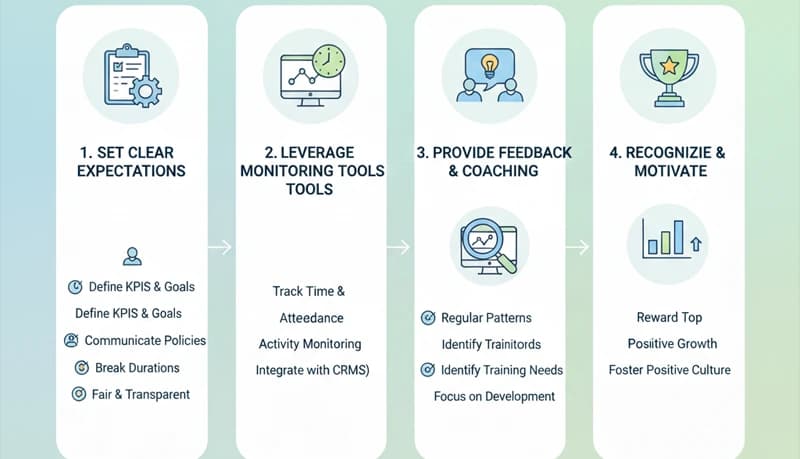
Productivity monitoring in a contact center is the practice of observing operational and agent-level data — in real time and historically — to identify what is working, what is not, and where to intervene. It is distinct from productivity tracking (the review cadence that structures when you look at data) and from workforce analytics (the analysis layer that answers broader questions about staffing, scheduling, and cost). Monitoring is the observation itself: what data to watch, what each signal means, and what action each signal should trigger.
The difference matters because most contact centers have monitoring tools (the ACD dashboard, the time tracking system, the WFM wallboard) but use them as passive displays rather than active management instruments. A wallboard showing that service level is at 62% is not monitoring — it is display. Monitoring means someone is watching that number, knows that 62% is below the 80/20 target, understands that it has been below target for 45 minutes, has diagnosed the likely cause (3 unplanned absences plus higher-than-forecast volume), and has initiated a response (voluntary overtime offer to the afternoon shift).
The data sources
Productivity monitoring in a contact center pulls from multiple systems. Each system provides a different piece of the picture.
| Data source | What it provides | Productivity questions it answers |
|---|---|---|
| ACD (Automatic Call Distributor) | Call volume by interval, queue times, abandon rates, calls per agent, AHT by agent and call type, service level by interval | Are agents handling the expected number of calls? Is AHT within target? Which intervals are understaffed? |
| Time tracking | Clock-in/out times, break durations, time by activity category (calls, training, admin, coaching) | Are agents working their scheduled hours? How much time is productive (on-phone) vs. off-phone? What is actual shrinkage? |
| WFM system | Schedule, forecast, staffing requirements, adherence | Are agents following the schedule? Is actual volume matching forecast? Is the operation staffed correctly for demand? |
| QA evaluations | Call quality scores by agent, rubric category scores, trend over time | Is the agent doing the work correctly, not just quickly? Are quality issues concentrated in specific agents, call types, or rubric categories? |
| CRM / ticketing | First call resolution, disposition codes, after-call work content, escalation frequency | Are agents resolving issues or passing them along? Is documentation adequate? Which call types generate the most rework? |
The integration requirement: These data sources are useful individually but powerful when connected. An agent with low AHT (fast) but low FCR (not resolving) looks productive on the ACD report but is generating callbacks — net negative productivity. Monitoring requires looking at multiple data sources together, not each in isolation. See workforce analytics for how to build the connected data layer.
What to monitor: real-time signals
Real-time monitoring answers the question: "Is the operation running correctly right now, and if not, what needs to happen in the next 30 minutes?"
| Signal | What it tells you | Normal range | Action trigger |
|---|---|---|---|
| Service level (current interval) | Whether enough agents are available to answer calls within the target time | 80/20 or per your SLA | Below target for 2+ consecutive intervals → check staffing vs. requirement. Intraday response needed |
| Calls in queue | How many customers are waiting right now | Fewer than 5% of agents logged in (e.g., fewer than 5 calls in queue for 100 agents) | Queue exceeding threshold for more than 10 minutes → overflow action, break deferrals, or VOT request |
| Agents available | How many agents are in "available" state (ready to take the next call) | 10–15% of agents logged in | Below 5% → agents are fully loaded with no buffer. Any additional call will queue. Above 25% → overstaffed for current volume |
| Longest wait time | How long the longest-waiting customer has been in queue | Fewer than 60 seconds for an 80/20 operation | Over 120 seconds → immediate attention. Customers abandon at increasing rates past this point |
| Adherence (current) | How many agents are in the activity they should be in per the schedule | 90%+ of agents in correct state | Below 85% → multiple agents off-schedule. Check for extended breaks, late returns from lunch, agents in ACW longer than expected |
| AHT (rolling current shift) | Whether the current shift's handle time is trending to target | Within 10% of target for the call mix | Rising AHT during the shift → investigate. Possible causes: new call type, system issue making lookups slow, agent mix (more new agents on this shift) |
Who watches real-time signals
| Role | What they monitor | Response authority |
|---|---|---|
| Supervisor | Their team's adherence, agent states, individual AHT | Coaching conversations, break management, agent-level intervention |
| WFM analyst / intraday manager | Service level, queue depth, staffing vs. requirement, forecast accuracy | Intraday adjustments: skill changes, overtime offers, schedule adjustments, break rescheduling |
| Ops manager | Escalated situations: sustained SL miss, staffing crisis, system outage | Authorization for mandatory overtime, cross-account moves (BPO), incident response |
What to monitor: historical signals
Historical monitoring answers the question: "Is the operation getting more or less productive over time, and why?" These are reviewed on a daily, weekly, and monthly cadence.
Agent-level signals
| Signal | What it reveals | What it does not reveal |
|---|---|---|
| AHT trend (4-week) | Whether the agent is getting faster, slower, or staying flat | Why. A rising AHT could be positive (agent is being more thorough, FCR is improving) or negative (agent is struggling with a new call type). Must be interpreted alongside FCR and QA |
| Calls per hour trend | Throughput — how many contacts the agent handles in a productive hour | Quality. An agent with rising calls/hour and falling QA scores is cutting corners to go faster |
| QA score trend | Whether call handling quality is improving, declining, or stable | Cause. A declining QA score may indicate a training gap, a new call type the agent has not been coached on, or burnout |
| Adherence trend | Whether the agent consistently follows the schedule | Intent. An agent with 88% adherence may have a childcare issue causing repeated late returns from break — a different situation than an agent who simply extends breaks |
| FCR | Whether the agent resolves issues on the first contact | Difficulty mix. An agent handling complex technical calls will have lower FCR than an agent handling address changes — raw FCR must be compared within the same call type |
The agent productivity profile: No single metric defines an agent's productivity. The combination creates a profile. For a framework that uses multiple metrics to categorize agent performance patterns (fast-thorough, fast-sloppy, slow-thorough, inconsistent, declining), see the agent productivity measurement guide.
Team and operation-level signals
| Signal | What it reveals | Review frequency |
|---|---|---|
| Service level trend (weekly) | Whether the operation is consistently meeting SLA or trending down | Weekly. A 4-week downward trend requires structural investigation — not just intraday fixes |
| Occupancy trend | Whether agents are busy enough (too low = overstaffed) or too busy (too high = burnout risk) | Weekly. Sustained occupancy above 88% degrades quality and accelerates attrition |
| Shrinkage actual vs. planned | Whether the staffing model reflects reality | Monthly. If actual shrinkage exceeds planned by 3+ points, the staffing calculation is wrong |
| Forecast accuracy | Whether the volume forecast is producing usable staffing plans | Weekly. Consistent over- or under-forecasting means every schedule is wrong |
| Overtime as % of total hours | Whether overtime is occasional (acceptable) or structural (a staffing problem) | Weekly. Above 5% for 3+ consecutive weeks = structural overtime |
| Attrition rate by tenure | Whether the operation is losing agents faster than it can replace them, and where in the lifecycle | Monthly. Early attrition (0–90 days) above 50% indicates training or onboarding problems |
The monitoring-to-action chain
Monitoring has no value unless it leads to action. Each observation should follow a chain: signal → diagnosis → decision → action → verification.
Example 1: AHT spike
| Step | What happens |
|---|---|
| Signal | Real-time AHT for the current shift is 7.2 minutes vs. a 5.8-minute target — 24% above target |
| Diagnosis | Check by call type: billing calls are at normal AHT, but technical support calls spiked to 11 minutes (normally 8). Check for a system issue or new problem type. Find that a client pushed a software update that is generating a new error — no troubleshooting flowchart exists for it |
| Decision | Create an interim resolution script. Route the new issue type to senior agents until the script is validated |
| Action | Supervisor distributes the interim script. WFM adjusts the AHT assumption for the forecast. Senior agents handle the new call type |
| Verification | Monitor AHT for the next 2 hours. Technical support AHT drops from 11 to 9 minutes with the interim script. Update the troubleshooting flowchart formally within 48 hours |
Example 2: Adherence decline on a specific team
| Step | What happens |
|---|---|
| Signal | Team B's weekly adherence dropped from 92% to 86% over 3 weeks |
| Diagnosis | Check individual adherence: 3 of 12 agents are below 80%. Check the pattern: all 3 are returning late from lunch (12–15 minutes late consistently). Check whether the schedule changed: the team's lunch break was moved to 11:00 AM (from 12:00 PM) in the latest schedule cycle to cover a mid-day volume peak |
| Decision | The early lunch time is the likely cause. Options: revert the lunch time, stagger lunches so some agents keep the later time, or coach the agents on the new expectation |
| Action | Supervisor has a team conversation about the schedule change, explains the reason, and asks for feedback. Two agents have a genuine constraint (school pickup at 11:45 requires the later lunch). Lunches are staggered: 6 agents at 11:00, 6 at 12:00 |
| Verification | Monitor adherence for 2 weeks. Team B returns to 91% |
Example 3: Declining FCR across the operation
| Step | What happens |
|---|---|
| Signal | FCR dropped from 74% to 68% over 6 weeks — a consistent downward trend across all teams |
| Diagnosis | Not agent-specific — all teams declined. Check by call type: FCR for "account inquiry" calls dropped from 82% to 65%. Check what changed: a new verification process was added 7 weeks ago that requires agents to send a verification email and wait for customer response before resolving. Calls that previously resolved in one contact now require a callback |
| Decision | The new verification process is the root cause. It was added for fraud prevention — removing it is not an option. But the process can be modified: agents can complete verification via SMS during the call instead of email after the call |
| Action | Process change: SMS verification replaces email verification for account inquiries. Training delivered on the new process |
| Verification | Monitor FCR for account inquiry calls over 4 weeks. FCR recovers from 65% to 78% (higher than the original 82% was not expected, since some calls still require callback for complex verification) |
What monitoring does not tell you
Every monitoring signal has limits. Misinterpreting what a signal means — or treating it as a complete picture — leads to wrong actions.
| Signal | What it does not tell you |
|---|---|
| Low AHT | That the agent is productive. Low AHT with low FCR means the agent is ending calls quickly without resolving them — creating callbacks that double the work |
| High adherence | That the agent is working effectively during scheduled time. An agent with 98% adherence who spends calls reading a script without listening to the customer will have high adherence and low quality |
| High calls per hour | That the operation is productive. High calls per hour can indicate short calls, which can indicate agents are not fully resolving issues or are rushing through required steps |
| Low QA scores | That the agent is not trying. Low QA may indicate a training gap, an uncalibrated evaluator, a rubric that penalizes an effective but unconventional approach, or an agent who handles disproportionately difficult calls |
| High service level | That the operation is at peak efficiency. Consistently high service level (e.g., 95/20 against an 80/20 target) may indicate overstaffing — the operation is paying for agents who are idle |
Monitoring for remote and hybrid agents
Remote and hybrid agents require additional monitoring considerations because the supervisor cannot observe the agent directly.
| In-office monitoring | Remote equivalent |
|---|---|
| Supervisor sees who is at their desk | Time tracking shows login/logout times compared to schedule |
| Supervisor notices an agent on an extended break | Activity monitoring shows time away from work applications |
| Supervisor overhears a difficult call and intervenes | Real-time call monitoring or listen-in capability from the ACD |
| Supervisor sees an agent struggling with a system and helps | Screen-level activity data shows whether the agent is navigating systems efficiently |
| Supervisor checks the team wallboard in the office | Remote dashboard access with the same real-time data |
What to avoid: Monitoring remote agents differently than in-office agents on metrics that should be the same. AHT, FCR, QA, adherence, and calls per hour should be measured identically regardless of location. If remote agents have different productivity outcomes, the investigation should focus on whether remote work eligibility criteria are correct — not on adding surveillance.
BPO monitoring additions
BPO operations monitor everything above plus client-specific dimensions.
| Additional signal | What it reveals |
|---|---|
| Per-client service level | Whether each client's SLA is being met. Aggregate SL can mask a client that is consistently below target |
| Per-client AHT and FCR | Performance differences across accounts. An agent may be productive on Client A but struggling on Client B — a training gap on Client B's product, not a general performance issue |
| Billable utilization | What percentage of paid hours are spent on client-billable activity. Non-billable time (training, bench, internal meetings) that is not tracked leads to overstated utilization |
| Client hour allocation accuracy | Whether cross-trained agents' hours are attributed to the correct client account. Misallocation distorts client-level productivity and cost metrics |
| Contract profitability indicators | Labor cost per client vs. revenue per client. If overtime on one account is eroding margin, monitoring catches it before the quarterly review |
Building the monitoring practice
Monitoring is not a tool purchase — it is an operational discipline. The tools (ACD, time tracking, WFM, QA system) provide the data. The practice is who watches what, when, and what authority they have to act.
| Element | What to define |
|---|---|
| Roles and ownership | Who monitors real-time signals (typically WFM or lead supervisor)? Who reviews historical trends (ops manager)? Who acts on each type of signal? |
| Escalation thresholds | At what point does a signal require escalation? Service level below 70% for 30 minutes → escalate to ops manager. Adherence below 80% for a team → supervisor investigates same-day |
| Review cadence | Real-time signals: continuously during shift. Historical signals: daily check, weekly review, monthly analysis |
| Documentation | When an action is taken in response to a monitoring signal, document what was observed, what was done, and what happened. This record builds institutional knowledge and prevents the same problem from being re-diagnosed from scratch each time it recurs |
| Feedback to agents | Agents should see their own metrics — AHT, adherence, QA scores, calls per hour. Monitoring that is visible only to management creates distrust. Monitoring that is visible to the agent enables self-correction |