

Overtime Calculator
Calculate a week's overtime pay under the federal 40-hour rule or the daily rules in California, Alaska, Colorado, and Nevada, with bonuses and shift differentials built into the regular rate.
1.5x for hours over 40 in the workweek. Applies in every state without a daily rule.
Regular hours
40
Overtime (1.5x)
8
Total gross pay for the week
$1,040.00
Overtime rate $30.00/hr
Straight-time pay (48 hrs)
$960.00
Overtime premium
$80.00
Want to see overtime before it happens? HiveDesk tracks hours as they are worked and flags employees approaching their overtime threshold.
Track it automatically →Quick Answer
Overtime pay is 1.5 times the regular rate for hours over 40 in a workweek. Total pay for the week is the regular hours at the regular rate plus the overtime hours at 1.5 times the regular rate.
Formula
Weekly pay = (Regular hours × Rate) + (Overtime hours × Rate × 1.5)
Example: at $20.00 an hour, a 48-hour week is 40 × $20.00 = $800.00 plus 8 × $30.00 = $240.00, for $1,040.00. For the 1.5x rate on its own, the time and a half calculator is quicker.
The Regular Rate: Where Most Overtime Errors Happen
Overtime is 1.5 times the regular rate, not necessarily the base hourly wage. The regular rate is all straight-time pay for the workweek divided by the hours worked. It includes nondiscretionary bonuses (promised for attendance, production, or quality), shift differentials, and commissions. It excludes discretionary gifts, paid time off, and expense reimbursements.
A weekly bonus
45 hours at $20.00 plus a $50 quality bonus: straight-time pay is $950.00, the regular rate is $21.11, and the 5 overtime hours add a half-time premium of $52.78. Total: $1,002.78. Paying the overtime at 1.5 times the $20 base and adding the bonus on top gives $1,000.00, which is $2.78 short.
Two jobs at different rates
30 hours at $18 and 15 hours at $24: straight-time pay is $900.00 for 45 hours, a weighted regular rate of $20.00. The 5 overtime hours earn a premium of 5 × 0.5 × $20.00 = $50.00. Total: $950.00. The one alternative is paying overtime at 1.5 times the rate for the work actually done during the overtime hours, which federal rules allow only if the employer and employee agreed to it before the work was performed.
Enter bonuses and differentials in the calculator's “Bonuses, shift differentials, or commission” field to see the adjusted rate. The payroll hours calculator covers the same rule over a whole pay period.
Daily Overtime: California, Alaska, Colorado, and Nevada
Federal law only counts overtime by the week. Four states also count it by the day, and when state and federal rules differ, the employee gets whichever is more generous. Each example below uses $20.00 an hour unless noted, and the calculator above applies the same rules.
California
1.5x after 8 hours in a workday and after 40 in a workweek; 2x after 12 in a workday; on the seventh consecutive day of the workweek, 1.5x for the first 8 hours and 2x after that.
One 13-hour day: 8 regular, 4 overtime, 1 double time hours = $320.00 (federal rule: $260.00)
California (seventh day)
Applies when the employee works all seven days of the workweek.
Six 8-hour days and a 10-hour seventh day: 40 regular, 16 overtime, 2 double time hours = $1,360.00 (federal rule: $1,340.00)
Alaska
1.5x after 8 hours in a day and after 40 in a week, for employers with four or more employees.
Four 10-hour days: 32 regular, 8 overtime hours = $880.00 (federal rule: $800.00)
Colorado
1.5x after 12 hours in a workday, 12 consecutive hours, or 40 hours in a workweek.
Three 14-hour days: 36 regular, 6 overtime hours = $900.00 (federal rule: $860.00)
Nevada
1.5x after 8 hours in a workday for employees paid less than 1.5 times the minimum wage ($18.00 in 2026), unless they agree to a scheduled four 10-hour days; 1.5x after 40 in a week for everyone else.
Four 10-hour days at $15 an hour (not on an agreed 4x10 schedule): 32 regular, 8 overtime hours = $660.00 (federal rule: $600.00)
Each state has exemptions and industry-specific rules that change these defaults, and California adjusts its exempt salary threshold every year. See overtime pay laws by state and the US state labor law guides before relying on a result for payroll.
Who Is Eligible for Overtime
The FLSA splits employees into non-exempt (owed overtime) and exempt (not owed overtime). Being paid a salary does not make someone exempt; the salary level and the job duties both have to qualify.
Non-exempt: overtime is owed
- Hourly employees, including part-time, seasonal, and temporary workers
- Salaried employees paid under $684 a week
- Salaried employees whose duties do not meet an exemption test
Exempt: overtime is not owed
- Executive, administrative, and professional employees paid at least $684 a week
- Highly compensated employees earning $107,432 or more with at least one exempt duty
- Outside sales and certain computer professionals
The $684 weekly salary level is the one the Department of Labor enforces after a federal court vacated the 2024 increase. Several states, including California, New York, Washington, and Colorado, set higher salary levels for exemption.
Salaried non-exempt employees are owed overtime too. If a salary covers a fixed 40-hour week, the regular rate is the weekly salary divided by 40. Under the fluctuating workweek method, where a fixed salary covers whatever hours are worked, the regular rate is the salary divided by all hours worked and overtime is paid at half that rate: $900 for a 50-hour week gives a regular rate of $18.00 and an overtime premium of $90.00. For the full tests, see exempt vs non-exempt employees and the FLSA exemption flowchart.
Overtime Rules Employers Often Get Wrong
Averaging across a pay period
Each workweek stands alone. 45 hours in one week and 35 in the next is 5 hours of overtime, even though a biweekly paycheck shows 80.
Refusing to pay unapproved overtime
Hours the employer knew or should have known about must be paid, approved or not. An approval policy can be enforced with discipline, not by withholding pay.
Offering comp time instead of pay
Private employers cannot substitute time off for overtime pay. Comp time in place of overtime is allowed only for public agencies.
Leaving bonuses out of the regular rate
Promised attendance, productivity, and quality bonuses raise the regular rate for the weeks they cover, so overtime for those weeks must be recalculated.
Paying late
Overtime is due on the regular payday for the period in which the workweek ends. If it cannot be calculated in time, it must be paid as soon as practicable and no later than the next payday after it can be.
Not counting pre-shift work
Logging in, starting required software, and required meetings are working time. In call centers these minutes are a common source of unpaid overtime claims.
Overtime Pay Spreadsheet Template
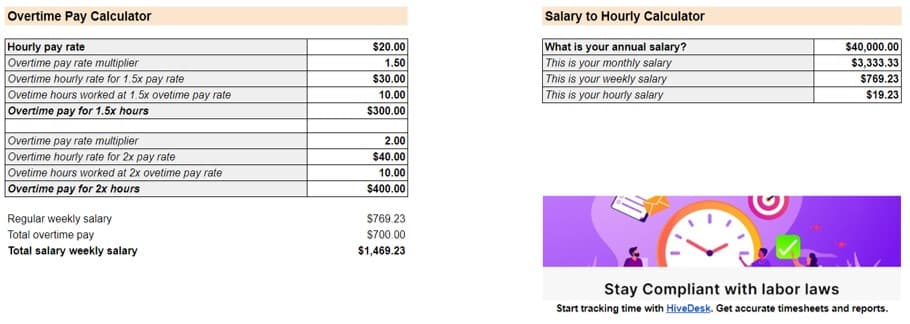
Need to calculate overtime for several employees at once? This Google Sheets template handles 1.5x and 2x rates. Make a copy in your own Google Drive and add a row per employee.
Managing Overtime Before Payroll
A calculator tells you what overtime costs after the week is over. Managing it means seeing it coming: who is at 36 hours on Thursday, which shifts keep running long, and which teams are understaffed. HiveDesk records hours as they are worked, shows each employee's running weekly total, and supports overtime management with alerts before thresholds are crossed. Approved timesheets then carry the correct regular and overtime hours into payroll.
See Overtime Coming, Not After the Fact
HiveDesk tracks hours in real time, alerts managers before overtime thresholds, and exports approved timesheets. $5/user/month, 14-day free trial.
Frequently Asked Questions
How is overtime calculated?
Under the FLSA, non-exempt employees earn 1.5 times their regular rate for every hour over 40 in a workweek. At $20.00 an hour, a 48-hour week is 40 hours at $20.00 plus 8 hours at $30.00, for $1,040.00. Each workweek is calculated on its own; hours cannot be averaged across two weeks.
What is the California overtime rule?
California pays 1.5 times the regular rate for hours over 8 in a workday and over 40 in a workweek, and double time for hours over 12 in a workday. On the seventh consecutive day worked in a workweek, the first 8 hours are paid at 1.5 times and any hours beyond 8 at double time. Hours already paid a daily premium do not count again toward the weekly 40.
Which states have daily overtime?
California, Alaska, Colorado, and Nevada. California and Alaska start daily overtime after 8 hours, Colorado after 12 hours in a workday or 12 consecutive hours, and Nevada after 8 hours for employees paid less than 1.5 times the state minimum wage. Everywhere else, overtime is weekly only.
What is the regular rate of pay?
It is the employee's total straight-time pay for the workweek divided by the hours worked. Nondiscretionary bonuses, shift differentials, and commissions are included, so the regular rate can be higher than the base hourly wage, and overtime must be paid at 1.5 times that higher rate. Discretionary gifts, paid time off, and expense reimbursements are excluded.
How do I calculate overtime with two different pay rates?
Use the weighted average. Add the straight-time pay for all hours at each rate and divide by total hours. For 30 hours at $18 and 15 hours at $24, straight-time pay is $900.00, the regular rate is $20.00, and the 5 overtime hours earn an extra half-time premium of $50.00, for $950.00 in total.
Are salaried employees eligible for overtime?
Yes, unless they are exempt. An employee is exempt only if they are paid a salary of at least $684 a week ($35,568 a year) and their duties meet an executive, administrative, professional, or other exemption test. Salaried non-exempt employees must be paid overtime, calculated from the hours their salary is intended to cover.
Does an employer have to pay overtime that was not approved?
Yes. Overtime must be paid for all hours the employer knew or should have known were worked, whether or not they were approved in advance. The employer can enforce an approval policy through discipline, but it cannot withhold pay for the hours.
Can a private employer give comp time instead of overtime pay?
No. Under the FLSA, compensatory time off in place of overtime pay is allowed only for public-sector employers. A private employer can let an employee take time off later in the same workweek to keep total hours at 40, but hours over 40 in a workweek must be paid as overtime.